A network of Civic Colleges
Our central proposal is the creation of a network of Civic Colleges: independent institutions, rooted in places. These would be sites of civic power and learning – places people can go to learn the disciplines that are vital to a thriving civic life, including from each other. We suggest starting with 8–12 Civic Colleges, providing a good spread across geographies.
This does not mean applying one mode of learning to all disciplines; a key feature of the colleges would be their diversity. This would be a range of very different institutions, each dedicated to the success of the relevant disciplines. Not every discipline needs a college per se, some might resist or not benefit from the formalisation or codification that a college might bring. Likewise, the formality of colleges might vary: some would have accredited courses with syllabuses, others might be less orderly places, busy from dawn to dusk with meetups, unconferences, and tacit knowledge exchange. What matters is having a secure and long-term space in which learning can flourish in the most appropriate way.
What would Civic Colleges be like?
Place 1 of 6
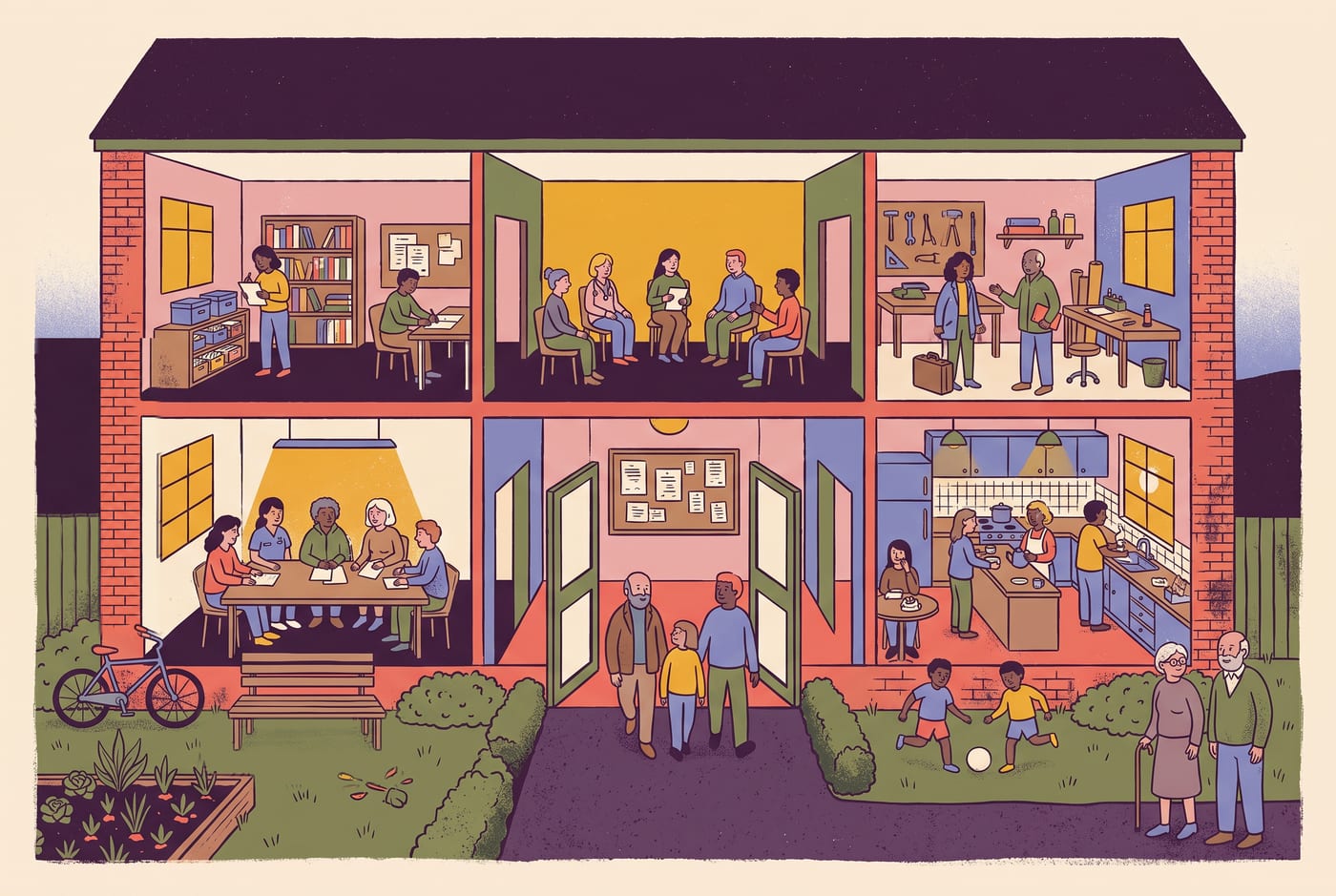
A peer-connector, community organiser, and a relational social worker might find themselves in the same room, learning a practice they all find important.
Practitioners can access literature and even historical artefacts to help deepen their understanding of their discipline.
Specialist technical training would be available, where useful, for example to learn the legal, financial, and logistical aspects of acquiring and renovating a community space.
Local civic leaders might meet to discuss how they are fostering the conditions for civic renewal in the local area.
The College could host a vibrant calendar of events for local people, as well as hosting visits and residencies, bringing practitioners from further afield.
This would be a civic institution in its own right, a place where people can gather, build relationships, and imagine a better future for their local area.
Note: In practice, the colleges would be a range of diverse institutions, some with accredited courses and syllabuses, others less orderly, many grown from existing institutions and buildings.
A civic college would be rooted in a place and would be independent of national and local government. It would offer learning across a range of the disciplines described in this report – likely more than one, but probably not all of them – in an integrative way. The colleges would, we believe, want to avoid the silos that have come to characterise academia and inhibit learning. A peer-connector, community organiser, and a relational social worker might find themselves in the same room, learning a practice they all find important. There would be specialist learning available too, where useful, for example to learn the technical, legal, and financial aspects of acquiring and renovating community spaces.
The Civic Colleges could host a vibrant calendar of visits and residencies, bringing in practitioners from other parts of the country and other fields. The Civic Colleges would also, of course, be civic institutions in their own right: perhaps housed in a heritage building with local cultural significance, and with an open programme and a public presence.
How would Civic Colleges be funded and governed?
We suggest an endowment model of funding, safeguarding the necessary security and independence. This speaks to one of our main findings: that support for disciplines is so often unreliable, limping from one grant or contract to the next. An endowed institution could take a 30+ year view of a discipline, which from our research appears to be the timescale over which this work matures (e.g. consider the rise of community organising).
The Civic Colleges could be capitalised via a blended mechanism combining public money with foundation capital. We note that in the latest estimates, UK and Irish universities secured around £1.55bn in new philanthropic funds in 2024-25, and US institutions around $61.5bn (roughly £48bn) in FY2024.4 Within this, there are significant contributions from High-Net Worth individuals and foundations, including to found university-based institutes with endowments. This is in addition to the more substantial flows of public money into academia. Perhaps in future a small portion of this funding could be usefully directed to Civic Colleges.
Civic Colleges would not be created anew, but would emerge organically and in different flavours rather than being imposed from the centre. Some would grow from existing institutions, likely including some of the backbone and enabling organisations named in this report. Others might be associated with existing settlement houses, further education colleges, or Universities with a serious civic mission.
There is a case for putting the Civic Colleges on a statutory footing, which might help to give them standing and longevity: it would help to settle the question of whether this work is regarded as a serious part of the national fabric. There is also a case for giving Civic Colleges a route to accredited status, such as for issuing degrees and other qualifications, though this was not named as a priority among the people we interviewed.
Learning from history
There is a long history of institutions with a similar flavour to Civic Colleges. This includes the rise of Mechanics’ Institutes from 1821, beginning with the Edinburgh School of Arts; the movement of settlement houses, such as the founding of Toynbee Hall in 1884; Ruskin College, founded in 1899; and the Workers’ Educational Association, formed in 1903 and still running. These are all examples of community- or democratically governed learning organisations.
There are also lessons here to learn from. It has been argued that Mechanics’ Institutes lost sight of their original focus, and many were absorbed into local authority provision. Ruskin College suffered from financial instability, and became part of the University of West London in 2021. These lessons should be taken into consideration for new institutions. They support the case for endowments and for a governance structure in which Civic Colleges own significant assets for themselves, including their buildings.
One interesting model is Denmark’s Folk High Schools (folkehøjskole). These were founded from 1844 by Nikolaj Frederik Severin Grundtvig (1783–1872), a theologian, philosopher, and education reformer, who argued for popular, non-credentialed adult education. There are around 70 such schools today, funded by a per-student state grant and tuition fees. Despite being state funded and rooted in statute, they set no entry requirements, hold no examinations, and award no qualifications. This is an interesting model for Civic Colleges to learn from, especially for disciplines less interested in formal learning.